


This article breaks down the methodology of the *Total Cost of Ownership*, analyzing elements such as maintenance, energy, security, and training. We offer a precise guide for an effective ERP comparison and well-founded strategic decision-making.
Fundamentals and the strategic value of TCO in technology investment
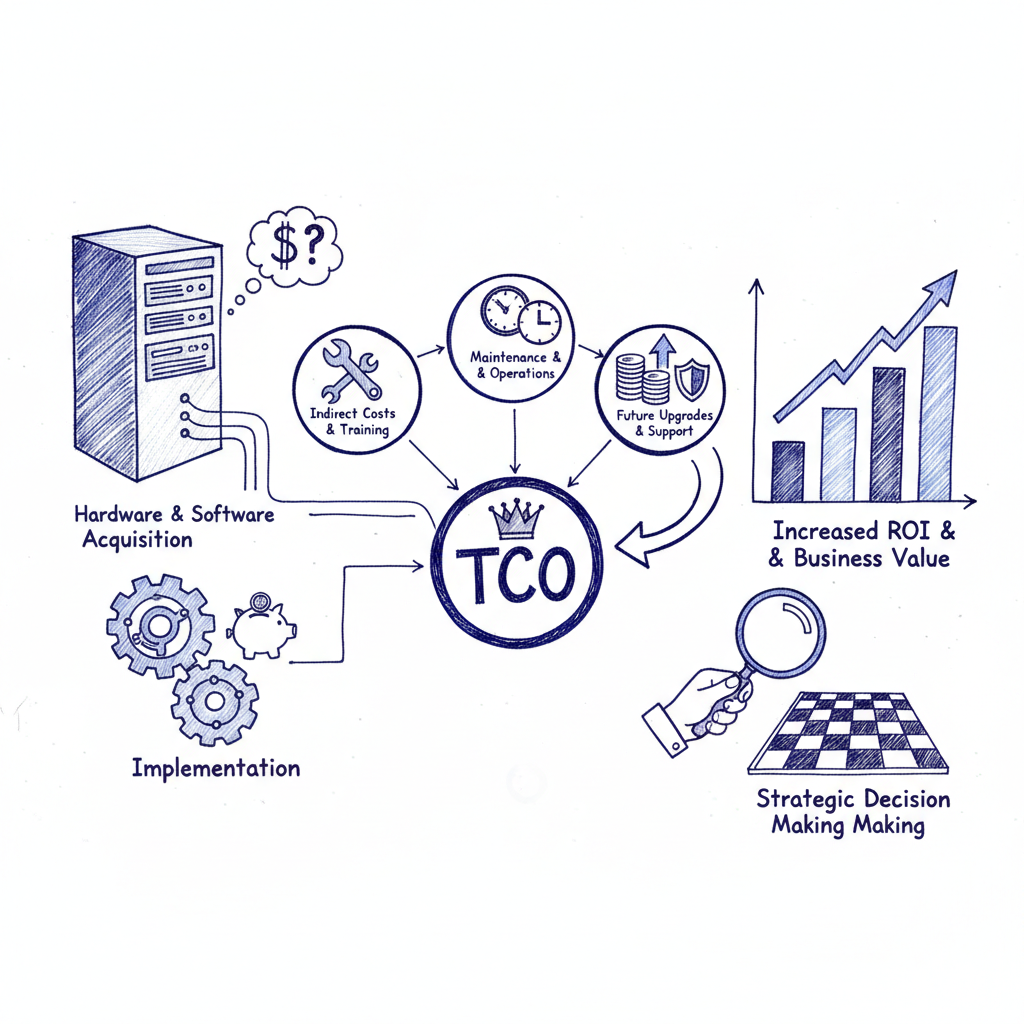
The total cost of ownership (TCO) represents a fundamental metric in enterprise technology management, going beyond the mere initial acquisition price. It offers a holistic perspective that encompasses all direct and indirect expenses associated with a technology asset throughout its complete lifecycle.
This comprehensive vision is crucial for differentiating the sticker price of a system from its true long-term value and cost. Ignoring this distinction can lead to serious financial surprises and imbalances in the IT budget, directly impacting business profitability.
Beyond the initial outlay, TCO considers a wide range of hidden IT costs and operational expenses. These include elements such as infrastructure, implementation and customization expenses, and the constant IT maintenance costs of software licenses.
Also incorporated are the integration cost with existing systems, the cost of ongoing technical support, and future updates. A thorough evaluation, vital for enterprise technology TCO, enables better forecasting and optimization of business resources.
The TCO perspective is vital in the ERP comparison and other complex solutions, directly impacting strategic IT decision-making. It facilitates the efficient allocation of resources, ensuring that investments truly drive digital transformation and do not become unexpected burdens.
To address this complexity, many companies rely on an experienced Microsoft partner within the ecosystem, such as KCP Dynamics. Their ability to lead digital transformation projects helps organizations break down and understand all these cost factors in solutions such as Microsoft Dynamics 365 and Azure.
This methodical approach is essential for technology risk reduction and for ensuring sustainable operational efficiency. It enables companies, with a presence in the Americas, Europe, and Asia, to make informed decisions that align with their long-term strategic and financial objectives.
Finally, a deep understanding of the total cost of ownership prevents shortsighted investments and promotes continuous and sustainable technological evolution. This ensures that every euro invested contributes to business growth, minimizing unexpected financial surprises.
Drive Your Digital Transformation with a Solid TCO Strategy
Discover how a holistic view of Total Cost of Ownership is key to the success of your digital transformation projects and risk reduction. Don’t let hidden costs hold back your progress!
Direct components of TCO: initial investment and tangible costs
Evaluating the total cost of ownership (TCO) in enterprise technology demands a meticulous breakdown of the most evident expenses. These direct components are the cornerstone of any rigorous analysis, reflecting the initial investment and tangible costs that directly impact an organization’s IT budget.
Initially, hardware acquisition represents a significant portion of this investment. This ranges from powerful servers such as Dell PowerEdge models in a data center in Barcelona, to network infrastructure like Cisco Catalyst switches, and end-user devices, such as Lenovo ThinkPad computers for 500 employees.
In parallel, software expenses are equally crucial. This includes licenses for vital enterprise applications, such as Microsoft Dynamics 365 Business Central for ERP management, or annual subscriptions to cloud services like Azure for scalable infrastructures, constituting a tangible recurring cost.
The implementation and integration phase carries its own direct costs. These include system configuration, data migration from legacy platforms, and integration with other corporate systems, an indispensable step for operational efficiency. An expert Microsoft partner like KCP Dynamics, with its global experience, is key to optimizing these processes.
Additionally, initial development or customization costs are essential for adapting solutions to the specific needs of the business. This may involve creating specific modules for a sector such as retail or manufacturing, ensuring that technology aligns perfectly with the strategic objectives of digital transformation projects.
Investment in support infrastructure is another direct category. This ranges from the fitting out of server rooms on a corporate campus in Mexico to APC uninterruptible power supply (UPS) systems and precision cooling solutions from Stulz. These elements are fundamental to the continuity and operational reliability of IT infrastructure.
Finally, expenses associated with deployment and initial updates are also counted as initial tangible costs. Ensuring a smooth launch and the most recent software versions from the outset is crucial to maximizing operational efficiency and avoiding future unexpected overruns in IT maintenance.
Clarify Your Initial Investment and Maximize TCO
The direct components of TCO are complex. Get an expert evaluation to break down and optimize every expense in your IT infrastructure and software from the start.
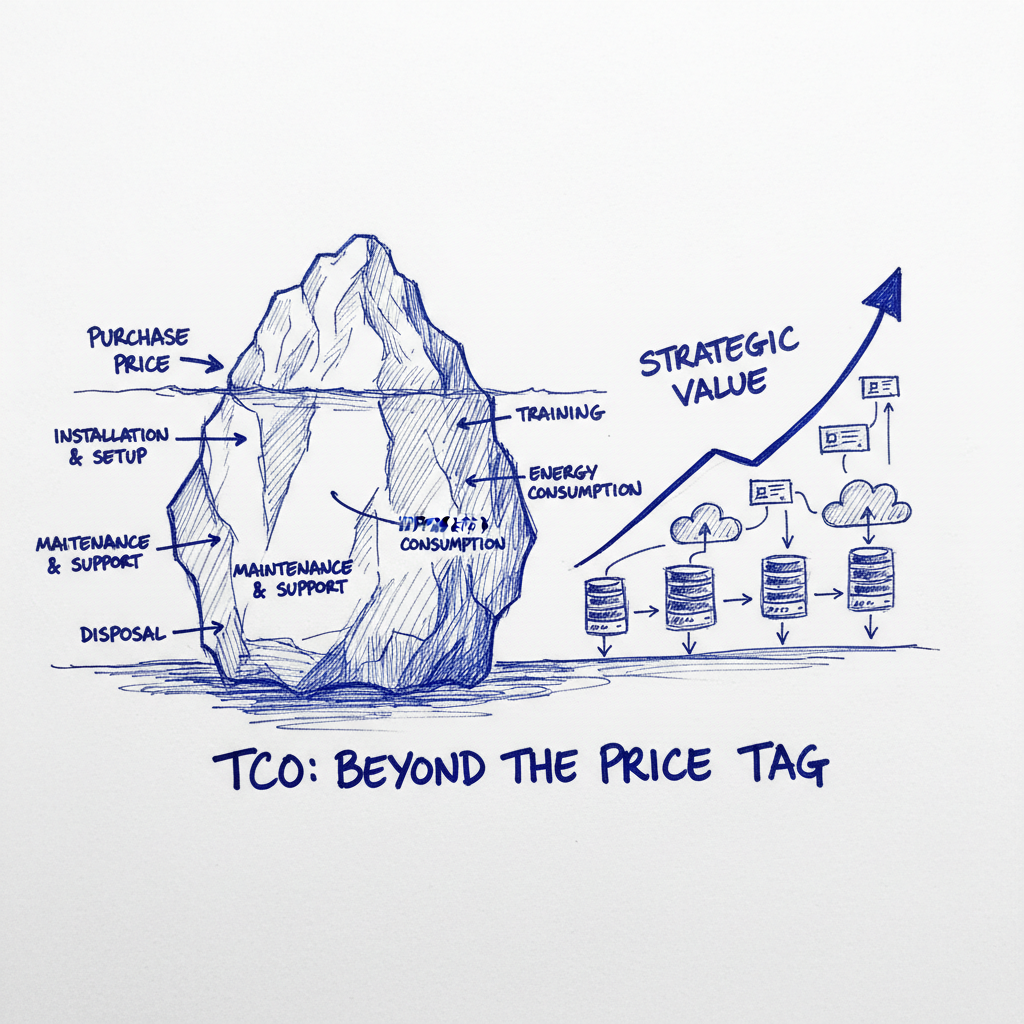
The true impact of the total cost of ownership (TCO) in enterprise technology is rarely limited to the initial investment. Hidden IT costs, those that lurk beneath the surface, represent the largest portion of the financial “iceberg.” It is estimated that these non-evident expenses can constitute up to 70% of the TCO over the lifecycle of a solution.
Preventive and corrective maintenance costs, along with technical support, are crucial and ongoing line items. These expenses range from the proactive resolution of incidents to the application of security patches and frequent software updates. Ignoring these needs leads to performance degradation and operational vulnerabilities.
Energy consumption of equipment, especially in high-performance local infrastructures, and IT security costs are impactful. A ransomware attack, such as those that affected large corporations in Europe in 2023, can generate millions in operational and financial losses, in addition to regulatory compliance expenses (GDPR, ISO 27001).
Staff training is another vital investment, as the adoption of new platforms requires continuous training to maximize their potential. Likewise, managing backups and implementing disaster recovery plans with cloud solutions, such as those offered by Microsoft Azure, are indispensable for operational resilience.
Technological obsolescence and asset depreciation also raise the enterprise technology TCO. Equipment and software depreciate rapidly, requiring costly renewals or migrations to maintain competitiveness. A well-planned lifecycle strategy is crucial to mitigating these impacts and maintaining operational efficiency.
To effectively address these challenges, having a Microsoft partner with global experience, such as KCP Dynamics, is fundamental. Their participation in various digital transformation projects ensures proper planning and execution. This allows for anticipating and managing the less evident operational costs and the risks inherent in technology adoption.
KCP Dynamics’ specialization in solutions such as Microsoft Dynamics 365, Power Platform, and Copilot, combined with its deep knowledge of legal and fiscal localizations, ensures a significant reduction of technology risks. This comprehensive approach translates into greater efficiency and exhaustive control over the total cost of ownership in the long term.
The TCO Iceberg: Up to 70% in Hidden CostsIt is estimated that indirect and hidden costs, including maintenance, security, and obsolescence, can constitute up to 70% of the Total Cost of Ownership (TCO) of enterprise technology over its lifecycle.
Advanced methodologies for TCO calculation and modeling
Evaluating the total cost of ownership (TCO) in enterprise technology goes beyond summing invoices, requiring structured approaches for a complete picture. It involves the precise quantification of all costs associated with a technology asset throughout its lifecycle, from acquisition to retirement.
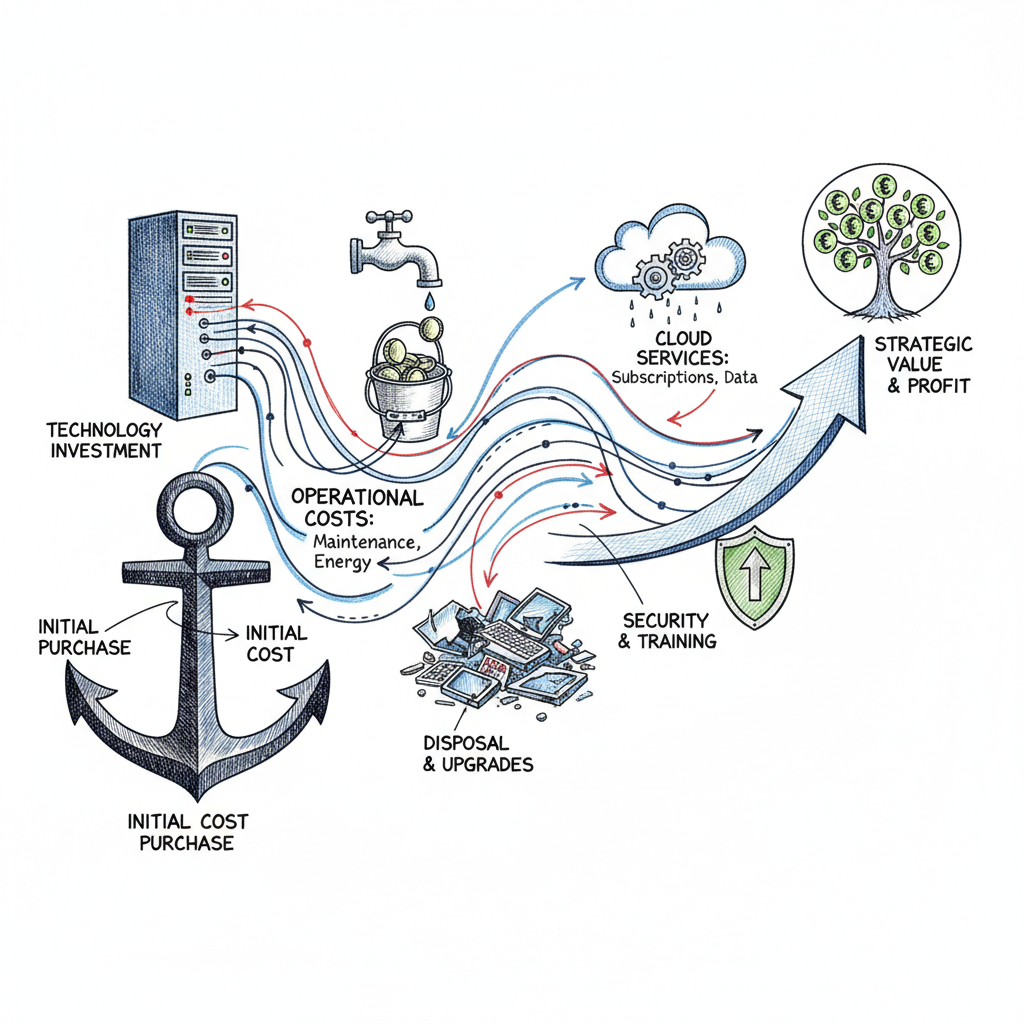
A fundamental methodology is the creation of lifecycle calculation models, which project not only the initial investment, but also IT maintenance, operational, deployment, and update costs. These models allow for anticipating the long-term financial impact of a technology solution.
For operationalization, dynamic spreadsheets and specialized templates are used, designed to capture and process a vast amount of data. These tools provide crucial flexibility to adjust parameters and run simulations, facilitating the modeling of enterprise technology TCO in great detail.
Integration with IT Asset Management (ITAM) and ERP systems is essential for obtaining accurate, real-time data. A Microsoft partner like KCP Dynamics, for example, facilitates the connection of solutions such as Microsoft Dynamics 365, ensuring a reliable source of information for TCO calculations.
The application of scenario analysis is vital for comparing different technology solutions and their financial implications. It allows for simulating the impact of variables such as user growth or changes in service rates, contributing to the reduction of technology risks associated with decision-making.
Building a robust TCO model requires considering elements such as integration cost and support cost, adapting to the specific needs of the company. This approach ensures that the ERP comparison or that of any other solution is well-founded and strategic.
KCP Dynamics, with its experience in digital transformation projects, integrates Power Platform and Power BI solutions to provide companies with advanced data analysis capabilities. This allows for proactively monitoring TCO, optimizing operational efficiency and resource allocation.
Ultimately, these advanced methodologies empower organizations to make informed technology decisions, ensuring that investment aligns with strategic objectives and that the total cost of ownership is effectively managed at every stage of the asset lifecycle.
Lifecycle ModelingProjects long-term costs (acquisition, maintenance, operational) for a complete financial picture.
ITAM/ERP IntegrationConnects with systems such as ITAM and ERP to ensure the accuracy and reliability of TCO data.
Scenario AnalysisCompares solutions and simulates variables to anticipate financial impacts and reduce risks.
TCO in cloud computing scenarios versus on-premise environments
The analysis of the total cost of ownership (TCO) in enterprise technology takes on a critical dimension when comparing cloud architectures with local (on-premise) infrastructures. The decision between adopting cloud services or maintaining one’s own infrastructure profoundly impacts the financial and operational strategy of any organization.
A fundamental difference lies in capital expenditure (CapEx) versus operating expenses (OpEx). While on-premise solutions demand a heavy initial investment in hardware, licenses, and a dedicated IT team, the cloud shifts this model toward an OpEx scheme, based on pay-per-use.
Scalability is another decisive factor in the enterprise technology TCO comparison. Cloud environments offer unprecedented elasticity, allowing companies to adjust their computing resources in real time. In contrast, on-premise infrastructures require long-term planning and the purchase of equipment that is often oversized.
Infrastructure management is a significant component of TCO. In the cloud, a large part of the IT maintenance costs and the support cost fall on the provider. Conversely, an on-premise environment requires qualified internal staff for deployment and updates, monitoring, and constant hardware and software support.
It is vital to consider data transfer costs, known as “egress fees,” when evaluating TCO in the cloud. These charges, generated when moving data out of the cloud provider, can raise operational costs unexpectedly if not managed properly from the start of the project.
Security and regulatory compliance also vary considerably. In the cloud, operations run under a shared responsibility model, where the provider guarantees the security of the infrastructure and the client that of their data. This aspect is crucial for companies operating in regions with strict regulations, such as the General Data Protection Regulation (GDPR) in the European Union.
The pay-per-use models of the cloud directly impact operational efficiency by eliminating the need to acquire and maintain idle equipment. This flexibility allows companies, such as a Microsoft partner, to focus their resources on innovation and digital transformation projects.
For example, KCP Dynamics, with its global experience, assists clients in the Americas and Europe in implementing solutions such as Microsoft Azure, ensuring an efficient migration that optimizes TCO. Its strategic approach considers legal and fiscal particularities, contributing to an effective reduction of technology risks and an informed adoption of the cloud.
| TCO Aspect | Cloud Computing | On-Premise Environment |
|---|---|---|
| **Initial Investment** | Minimal or none (OpEx-based) | High (CapEx in hardware, licenses, infrastructure) |
| **Cost Model** | Operational (OpEx) – Pay-per-use | Capital (CapEx) and Operational (OpEx) |
| **Scalability** | High and elastic, real-time adjustment | Limited, requires planning and equipment purchase |
| **Management and Maintenance** | Primarily the provider’s responsibility | Entirely the responsibility of the internal IT team |
| **Security Responsibility** | Shared (Provider: infrastructure, Client: data) | Entirely the client’s responsibility |
| **Additional Costs** | Data transfer (egress fees), over-provisioning due to lack of knowledge | Oversizing, obsolescence, energy, cooling |
| **Resource Focus** | Innovation and business projects | Infrastructure operation and maintenance |
Proactive strategies for TCO optimization and reduction
Managing the total cost of ownership (TCO) in enterprise technology demands a proactive approach to minimize expenses without compromising performance. It is crucial to implement strategies that allow for constant optimization, ensuring innovation and robust security. This implies a continuous improvement manual focused on value.
A fundamental strategy lies in negotiating contracts with suppliers. Reviewing existing agreements and seeking better conditions can significantly reduce annual operational costs. Negotiating volume or scalable licenses, for example, has allowed companies in Barcelona to save up to 15% on software.
The standardization of platforms and technologies is another key pillar. By opting for unified solutions, support is simplified and infrastructure complexity is reduced. A good ERP comparison can reveal that consolidating on a single platform, such as Microsoft Dynamics 365, minimizes future integration costs.
The automation of IT processes drives operational efficiency and reduces dependence on manual interventions. Orchestration tools and automatic service management reduce errors and IT maintenance costs. This is vital for critical operations in data centers, from Frankfurt to Mexico City.
Implementing lifecycle management policies for software and hardware is essential. Planned updates and the strategic retirement of obsolete equipment prevent hidden IT costs. This optimizes deployment and updates, extending the useful life of assets and planning capital investments intelligently.
Optimizing energy consumption in data centers and offices is a direct tactic. Investing in more efficient hardware and intelligent cooling systems drastically reduces energy bills. A 2023 study indicated that migrating to greener infrastructures can reduce these operational costs by up to 20% annually.
Finally, continuous training programs maximize staff efficiency and technology adoption. A well-trained team reduces the need for external support costs and accelerates digital transformation. An expert Microsoft partner like KCP Dynamics, with its global experience, facilitates this training to make the most of solutions.
These joint strategies form a robust manual for the continuous improvement of TCO. The disciplined application of these actions mitigates risks and ensures a sustainable return on investment. With proper planning, an effective reduction of technology risks is achieved without sacrificing the path toward business innovation.
Strategic NegotiationReduces operational and licensing costs by up to 15% through renegotiation with suppliers.
Platform StandardizationSimplifies IT infrastructure, reducing complexity and future integration costs.
Process AutomationDrives operational efficiency, reduces errors, and the costs associated with manual IT maintenance.
TCO as a tool for technology risk management and resilience
The total cost of ownership (TCO) in enterprise technology goes beyond the acquisition price, establishing itself as a vital strategic framework for risk management. It allows organizations to proactively identify, quantify, and mitigate technological vulnerabilities before they generate greater expenses. A holistic approach to TCO is fundamental for modern enterprise technology TCO.
Security breaches represent one of the most costly threats, generating not only direct losses from compromised data, but also regulatory fines and reputational damage. Recent studies indicate that the average cost of a data breach globally can amount to millions of dollars, severely affecting the total cost of ownership in the long term. Companies in Europe and Latin America are particularly susceptible to these incidents.
Service interruptions, whether due to hardware, software, or network failures, entail significant hidden IT costs. These include loss of productivity, customer dissatisfaction, and, in extreme cases, the total paralysis of business operations. Regulatory non-compliance, such as data protection regulations, also translates into high financial penalties, directly impacting operational costs.
Technological obsolescence is another critical risk that increases the total cost of ownership. Maintaining outdated systems not only limits innovation, but also raises IT maintenance costs and increases exposure to unpatched security vulnerabilities. The lack of operational resilience prevents rapid recovery from incidents, magnifying losses.
Strategically investing in advanced cybersecurity and disaster recovery plans (DRP) is a proactive measure that significantly reduces TCO in the long term. These investments are considered a reduction of technology risks, protecting digital assets and ensuring business continuity. Proper planning is essential to mitigate interruptions.
System modernization is a fundamental pillar in the TCO strategy, preventing future integration costs and support costs associated with obsolete platforms. Through digital transformation projects, companies can adopt more secure and efficient infrastructures. This includes the implementation of solutions with integrated artificial intelligence, such as Copilot, to optimize processes.
A strategic Microsoft partner like KCP Dynamics, with its experience in solutions such as Dynamics 365 and Azure, facilitates these intelligent investments. Its focus on localization and security helps companies in the Americas, Europe, and Asia to strengthen their resilience. They protect business value by preventing unforeseen costs and ensuring agile operations.
In short, TCO is an indispensable tool for building robust technological resilience and safeguarding business value. A proactive analysis not only optimizes operational costs, but also strengthens operational efficiency and the organization’s capacity to navigate future challenges. This ensures a sustainable competitive advantage.
The content provided details how TCO goes beyond the acquisition price to become a vital strategic tool for technology risk management and resilience. It describes various risks (security breaches, service interruptions, technological obsolescence) and how proactive investment in cybersecurity, DRP, and modernization, guided by TCO, mitigates these risks and reduces long-term costs.Given that the text emphasizes multiple benefits and aspects of how TCO helps in risk management and building resilience, the **FEATURES GRID** is the most appropriate visual element. It allows for clearly and concisely breaking down the key value points of TCO in this context.
Proactive Risk ManagementTCO identifies and quantifies vulnerabilities, enabling technology risks to be mitigated before they escalate into greater costs.
Reduction of Breach CostsInvestment in cybersecurity and DRP is a TCO strategy that minimizes the financial impact of incidents and regulatory fines.
Fostering Technological ResilienceDrives system modernization, ensuring business continuity and the capacity for rapid recovery in the face of challenges.
Conclusions and final recommendations
Managing the total cost of ownership (TCO) in enterprise technology transcends the mere initial investment, revealing itself as a strategic pillar for informed decision-making. This in-depth analysis is fundamental for uncovering the true value and sustainability of technology investments throughout their lifecycle.
Key points to remember
- Comprehensive TCO Vision: TCO analysis encompasses much more than the purchase price, incorporating direct, indirect, and frequently overlooked hidden IT costs.
- Strategic Investment: Applying TCO transforms technology acquisition decisions into strategic investments, aligned with long-term objectives and business resilience.
- Cloud vs. On-premise Differences: Cloud computing architectures and on-premise environments present distinct TCO structures, requiring customized evaluation methodologies for a precise ERP comparison .
- Continuous Optimization: TCO is not a static calculation, but a dynamic process of optimization and reduction, driven by proactive strategies and constant management.
- Risk Management: Understanding TCO is a powerful tool for identifying and mitigating technology risks, strengthening the organization’s agility and responsiveness to change.
- Foundation for Digital Transformation: A well-managed TCO is the foundation upon which companies can build their digital transformation in a sustainable and profitable manner.
Practical recommendations
We urge companies to adopt a holistic mindset in their TCO evaluation, going beyond initial figures to identify and quantify hidden IT costs. Implementing a robust framework for the calculation and modeling of the total cost of ownership allows for anticipating expenses, optimizing resources, and ensuring that every technology investment contributes to the long-term value of the organization. Considering the complete lifecycle of a solution is crucial to avoiding surprises and guaranteeing true operational efficiency.
To address the inherent complexity of enterprise technology TCO, especially in the context of an ERP comparison or cloud migration, it is vital to have an expert partner. Organizations such as KCP Dynamics, with their vast experience in implementing and optimizing Microsoft Dynamics 365, Azure, and Power Platform solutions, offer the necessary guidance to navigate this complexity. Their global approach, combined with deep knowledge of legal and fiscal localizations, ensures that your company’s digital transformation is carried out with agility, security, and an optimization of the total cost of ownership. The integration of AI tools (Copilot) and data analysis (Power BI) that KCP Dynamics provides facilitates decision-making based on real-time information, driving continuous and sustainable technological evolution.
Embracing the discipline of TCO is not just a financial practice, but a management philosophy that empowers companies to build a more robust and predictable technological future. Intelligent investment today defines the competitiveness of tomorrow.
Comprehensive TCO VisionTCO encompasses direct, indirect, and hidden costs, beyond the initial purchase price.
Strategic InvestmentTransforms technology decisions into investments aligned with long-term objectives and resilience.
Cloud vs. On-premiseRequires customized evaluations for a precise comparison between architectures.