



The demo dazzles. The steering committee approves the budget. The team kicks off with energy. And three months later, the project is at a standstill. This pattern of ERP project stagnation is not an exception in LATAM: it is the norm. According to Gartner analysis, more than 70% of ERP implementations fail to meet their original business objectives. The problem is not the technology. It lies in the decisions that are made—and those that are not made—before, during, and right after go-live.
If you are a CTO, head of digital transformation, or CEO of a mid-sized or large company in the region, this article is an unfiltered diagnosis of what really happens on the ground.
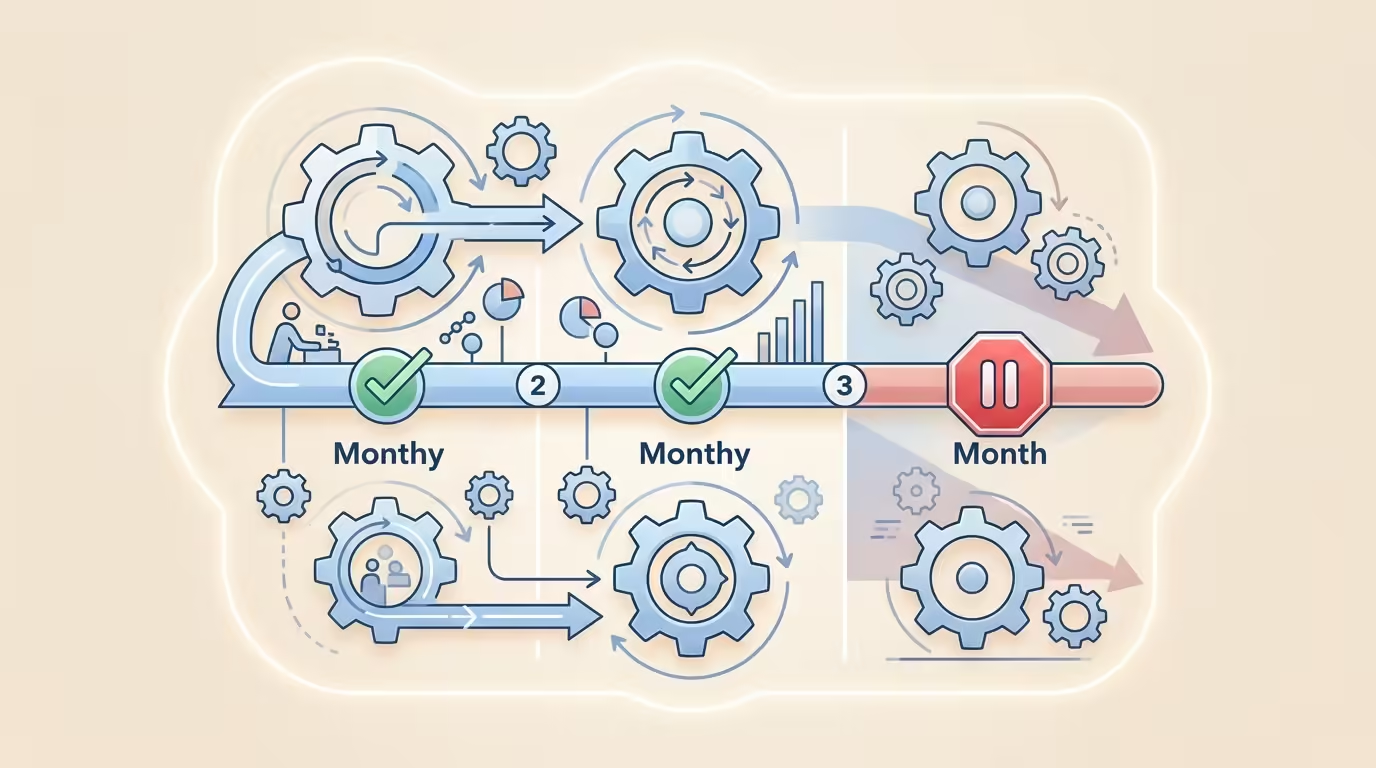
Why month 3 is the breaking point
Month 3 concentrates the highest density of critical decisions in any ERP implementation. It is the moment when initial enthusiasm collides with operational reality: processes mapped on paper do not match actual workflows, migrated data presents inconsistencies, and key users—who promised availability—remain absorbed by their day-to-day responsibilities.
In projects that KCP Dynamics has accompanied in manufacturing, retail, and financial services in LATAM, this is the moment when the steering committee begins to receive ambiguous reports: progress that looks good on paper but conceals real blockages on the ground. Without clear implementation metrics, no one can distinguish real progress from fictitious progress.
What makes month 3 especially dangerous is that the project has not yet generated any visible ROI, but has already consumed between 40% and 60% of the budget. The cost of stopping at that point is high. The cost of continuing without correcting course is even higher.
Root cause 1: silent scope creep from day one
Scope creep—the uncontrolled expansion of scope—rarely arrives as an explicit decision. It arrives as a series of small concessions: “let’s add this report,” “let’s also integrate this module,” “the sales team needs this additional screen.” Each request seems reasonable in isolation. Together, they can double the implementation time without anyone having made a formal decision to expand the project.
In the LATAM context, this problem is amplified by two specific reasons. First: companies in the region tend to operate with highly customized processes, often undocumented, that emerge during implementation as “essential” requirements. Second: the cultural pressure not to say no to internal stakeholders causes project teams to accumulate scope changes without formally escalating them.
Scope creep warning signs
The clearest signal: when the project plan is updated more than twice in the first month without a formal scope change decision, scope creep is already active. Other signals include steering meetings where “minor adjustments” are approved without written records, or consultants working on functionalities not included in the original contract.
How to fix it
The solution is not bureaucracy; it is governance. A simple change log, reviewed weekly by the steering committee, can contain the problem before it becomes irreversible. If your project does not have a formal change control process with steering committee approval, any verbal request from a manager can turn into weeks of unplanned work.
Root cause 2: dirty data that nobody wants to clean
Data migration is the most underestimated task in any ERP implementation. Teams assume their databases are in good shape. The reality, in most projects we have seen in LATAM, is different: duplicate records, inconsistent product codes across plants, customer master records with empty fields, and chart of accounts that nobody has reviewed in years.
Dirty data does not block go-live. What it does is destroy trust in the system right after it. When a user opens the ERP and finds that their most important customer has three different records with contradictory information, the immediate conclusion is that the system “doesn’t work.” From that point on, they go back to Excel. And the ERP becomes an additional layer of work, not the source of truth it was meant to be.
The post-go-live diagnosis of stalled projects in LATAM shows a consistent pattern: data cleansing was left for the migration phase, when there is already time pressure, instead of starting in the design phase. Dedicating between 10% and 15% of the total project budget to data governance and quality before migration is not an extra expense: it is the insurance that prevents having to redo the work.
Root cause 3: the ERP is treated as an IT project, not a business transformation

This is perhaps the most costly mistake and the hardest to correct once the project is underway. When the ERP implementation falls under the exclusive responsibility of the technology department, a fatal decoupling occurs: the IT team optimizes for the system to work technically, while the business continues operating as before.
The symptoms are recognizable. Finance, operations, and sales departments participate in requirements-gathering workshops, but do not take ownership of the redesigned processes. Functional leaders sign approval documents without having reviewed in detail what they are approving. And when go-live arrives, no one from the business feels responsible for ensuring the system is used correctly.
In LATAM, this pattern is seen with particular frequency in manufacturing and retail companies that have grown quickly and where operational managers have little tolerance for disruption to their routines. The solution involves designating functional champions—people from the business, not from IT—with dedicated time for the project and real authority to make process decisions.
- Executive sponsor with active presence in steering meetings
- Functional champions with dedicated time (minimum 50%)
- Adoption KPIs defined before go-live
- Change management plan approved from phase 0
- The project is led solely by the IT department
- Functional managers “don’t have time” for the ERP
- No adoption metrics have been defined
- The training plan is designed in the last month
Root cause 4: absence of real implementation metrics
How does your team know the project is going well? If the answer is “because the schedule says we are on time,” you have a problem. ERP project schedules measure completed activities, not value generated. A project can be “80% complete” according to the plan and, at the same time, be weeks away from total failure.
The implementation metrics that really matter are different from those on the schedule. They include: the percentage of users who have completed training and can operate the system autonomously; the rate of transactions processed correctly in the system versus those still being done outside it; the number of support tickets open by module in the first two weeks post-go-live; and the average resolution time for critical incidents.
In well-managed projects that we have accompanied at KCP Dynamics, these metrics are defined before go-live and reviewed in a weekly dashboard during the first 90 days. Without this monitoring, the post-go-live diagnosis arrives too late: when the management team already perceives that “something is not working” but has no data to understand what or where.
Root cause 5: unmanaged resistance to change
Resistance to change is not irrational. It is the natural response of people who have been doing their job a certain way for years and are now being asked to learn a new system, with new workflows, in the middle of their usual responsibilities. Ignoring this resistance does not eliminate it: it turns it into passive sabotage.
In LATAM, resistance has specific nuances. In companies with high staff turnover—common in retail and services—the team that was trained on the ERP may not be the same one operating it at go-live. In organizations with marked hierarchical structures, if the middle manager does not use the system, the team will not use it either. And in contexts where the ERP replaces informal processes that gave certain people power, resistance can be active and organized.
Change management methodologies applied to ERP
Frameworks such as ADKAR (Prosci) or Kotter’s 8-step model offer proven structures for managing this transition. ADKAR, in particular, is useful in ERP implementations because it breaks down change into five individual conditions—Awareness, Desire, Knowledge, Ability, Reinforcement—that allow you to diagnose exactly where adoption is failing person by person, not just at the module level. In practice, many projects in LATAM jump directly to “K” (technical training) without having built “A” (awareness of the why) or “D” (motivation to change), which condemns training to being a formality rather than an adoption lever.
Change management is not a two-hour workshop before go-live. It is a continuous process that begins in the design phase, includes regular communication about the “why” of the change, and is sustained with real support during the first 60 days of operation in the new system.
Root cause 6: LATAM's regulatory and tax complexity underestimated

LATAM is not a homogeneous market. Mexico has CFDI electronic invoicing requirements with versions that are updated periodically. Brazil operates under SPED and a tax structure that combines federal, state, and municipal taxes with complex tax credit rules. Colombia, Chile, Peru, and the Dominican Republic have their own electronic invoicing schemes and mandatory tax reports. An ERP configured without contemplating these particularities from the design phase will generate compliance problems from the first day of operation.
The most frequent mistake is assuming that the ERP “already complies” with local regulations because the vendor has a presence in the region. The reality is that correct tax configuration requires country-specific knowledge, and that regulatory updates—which are frequent in LATAM—must be covered by the implementing partner’s support model.
In multinational projects operating in several countries of the region simultaneously, this factor can become the bottleneck that paralyzes go-live in entire markets. The recommendation is to validate, country by country, that the implementation team has proven experience with the current local regulations—not just with the technology platform. If you work with Microsoft Dynamics 365, make sure your partner knows the specific tax localizers for each market in the region.
Root cause 7: the implementation partner has no real experience in LATAM
Not all implementation partners are equal. There is a significant difference between a partner with global certifications and a partner with real cases of successful go-live in manufacturing in Mexico, retail in Colombia, or financial services in Chile. Certifications accredit knowledge of the platform. Experience in LATAM determines whether the partner understands the context in which you are going to operate.
The symptoms of a partner without regional experience are recognizable: methodologies imported directly from European or North American projects without local adaptation, time estimates that do not account for the tax complexity of each country, and consulting teams that do not speak the language of the business—literally and figuratively.
Partner selection is probably the most important decision in the entire process. Requesting verifiable references from completed projects in the region, with companies of similar size and sector to yours, is not a luxury: it is the minimum requirement before signing an implementation contract.
Self-assessment checklist: is your project at risk?
Before reaching the post-go-live diagnosis, you can do a quick read of the state of your implementation. If you check more than four items in the risk column, your project needs intervention now, not at the next steering meeting.
| Dimension | ✅ Healthy signal | 🚨 Risk signal |
|---|---|---|
| Governance | Active steering committee with weekly minutes | Irregular steering meetings or without written agreements |
| Scope | Change log updated and formally approved | Changes approved verbally or without a record |
| Data | Cleansing process started in the design phase | Data cleansing pending for “before go-live” |
| Adoption | Adoption KPIs defined and measured weekly | No adoption metrics defined yet |
| Champions | Functional champions with at least 50% dedication | Functional managers participate “when they can” |
| Regulatory | Tax configuration validated by country from design | Tax compliance pending review |
| Change management | Change management plan active from phase 0 | Training planned for the last month of the project |
Post-go-live diagnosis: how to know if your project is at risk and what to expect from a rescue
If your implementation is already underway and you recognize several of the patterns described in this article, the first step is an honest diagnosis. Not to find someone to blame, but to understand exactly where the blockage is and what is needed to unblock it.
An effective post-go-live diagnosis reviews five dimensions: real adoption by module and by area, data quality in production, compliance with redesigned processes versus the actual processes the team is using, status of the incident backlog, and alignment between the original project KPIs and the measurable results to date.
Typical timelines and cost of an ERP rescue
One of the questions that most paralyzes management teams is: “How much is it going to cost us to fix this?” The answer depends on the moment of intervention, but the projects we have accompanied in LATAM show consistent ranges. A project detected in month 3 or 4 typically requires between 6 and 10 weeks of structured intervention to stabilize adoption and resume the original roadmap. The recovery budget usually falls between 15% and 25% of the total original project budget—significant, but far less than the cost of abandonment or a complete redesign.
Projects that are allowed to escalate until month 6 or beyond without intervention enter a different category: recovery may require between 4 and 6 additional months and a rescue budget that exceeds 40% of the original. Every month of delay in diagnosing the problem multiplies the cost of resolving it. This is why weekly implementation metrics are not a management luxury: they are the early warning system that makes it possible to intervene before the rescue becomes prohibitive.
Real case: rescue in manufacturing in Mexico
An industrial components manufacturer in the Bajío region (Mexico) reached month 4 with an adoption rate of 18% in the operations module: operators were still using spreadsheets to record production orders because the ERP “took too long.” The diagnosis revealed three simultaneous problems: material master data with inconsistencies that generated errors in orders, the absence of a functional champion on the plant floor with authority to validate the new workflows, and a training plan that had been executed six weeks before go-live with no subsequent reinforcement.
The intervention lasted eight weeks and included a focused cleansing of the 2,400 most active SKUs, the designation of two shift supervisors as champions with partial dedication, and reinforcement sessions on the plant floor using real production cases. At the close of the intervention, the adoption rate in operations reached 74%, and the order registration time was reduced by 40% compared to the previous manual process. The cost of the rescue represented 19% of the original project budget.
ERP project stagnation is almost never irreversible. But it does require early intervention, real data on the current state, and a recovery plan with concrete milestones—not generic promises to “regain momentum.” You can explore how KCP Dynamics structures these rescues on the Implementation Blueprint page, where we detail the phased approach for projects in recovery.
The difference between a project that stagnates and one that generates measurable ROI is not in the technology platform chosen. It lies in the methodology, governance, data quality, and change management. These are the factors that KCP Dynamics places at the center of every implementation in the region.
Frequently asked questions
Why does ERP project stagnation occur so frequently in month 3?
Month 3 is the point where initial enthusiasm collides with operational reality: migrated data presents problems, key users do not have real availability, and accumulated scope creep begins to impact the schedule. Furthermore, it is the moment when the project has consumed significant budget without having generated visible ROI, which creates additional pressure on the team.
What are the most important implementation metrics to monitor?
The most critical are: adoption rate by module (percentage of transactions processed in the ERP versus outside it), number of support tickets open by area, percentage of users who operate the system autonomously, and resolution time for critical incidents. These metrics must be defined before go-live and reviewed weekly during the first 90 days.
What distinguishes an implementation partner with real experience in LATAM?
A partner with real experience in LATAM has verifiable cases of successful go-live in countries in the region, up-to-date knowledge of the tax regulations of each market (CFDI in Mexico, SPED in Brazil, electronic invoicing in Colombia, Chile, Peru, Dominican Republic), and methodologies adapted to the local context—not imported directly from European or North American projects.
Is it possible to recover an ERP project that is already stalled?
Yes, in most cases. The first step is an honest diagnosis that identifies the real blockage: failed adoption, poor data quality, uncontrolled scope, or lack of governance. With that information, it is possible to design a recovery plan with concrete milestones. Early intervention—before the management team loses confidence in the project—is key to the success of the rescue.
How does LATAM’s regulatory complexity affect implementation timelines?
Significantly. Each country has different electronic invoicing schemes, tax reports, and compliance requirements that must be correctly configured from the design phase. If this complexity is not accounted for in the original plan, it can generate go-live blockages in entire markets or compliance problems from the first day of operation.