



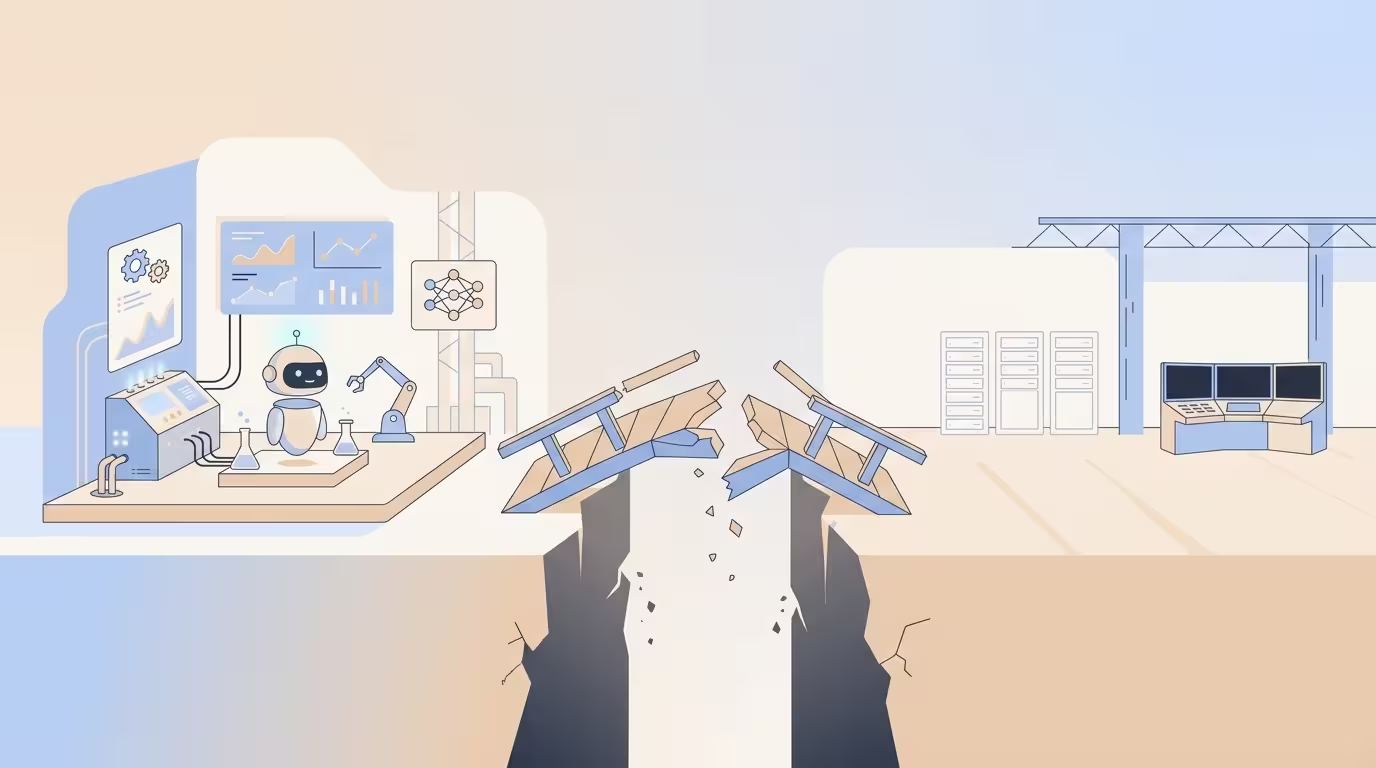
The demo dazzles. The pilot launches with enthusiasm. And three months later, the project is stalled — or worse, it survives in a PowerPoint that nobody opens again. This pattern has a name: it’s the gap between pilot and production, and it’s the most expensive problem in enterprise AI in LATAM today. AI projects that don’t scale are, in practice, the main obstacle to real digital transformation in the region.
The numbers are uncomfortable but necessary: 95% of generative AI pilots generate no measurable return, according to the MIT report “The GenAI Divide: State of AI in Business 2025.” This is not a technology failure. It’s a failure in how projects are designed, governed, and scaled. At KCP Dynamics we see this repeat with a regularity that no longer surprises us — though it remains avoidable. Every time an AI initiative fails to reach production, it joins the growing list of AI projects that don’t scale and drain budget without return.
The real problem: AI projects that don't scale don't fail because of technology
When an AI pilot fails, the first instinct is to look for technical culprits: the model wasn’t accurate, the data was dirty, the infrastructure couldn’t handle it. But 70% of AI adoption problems are tied to people and processes, not algorithms. The technology, in most cases, works. What doesn’t work is the organizational context in which it tries to operate. AI initiatives that never reach production — AI projects that don’t scale — almost always share this same pattern of organizational, not technological, failure.
Ver los datos
| Dato | Qué significa |
|---|---|
| 95 % | de los pilotos de IA generativa no genera retorno medible |
| 70 % | de los problemas de adopción de IA están ligados a personas y procesos, no a algoritmos |
| 12 % | de las empresas en LATAM tiene un sistema formal de gobernanza de IA |
In the projects we accompany at KCP Dynamics, we have identified a clear pattern: pilots are designed to impress, not to scale. Use cases are chosen that shine in a demo — response speed, clean interface, eye-catching outputs — but that are not connected to a real business process, to production data, or to the workflows of the team that should use them every day. That is how AI projects that don’t scale are born: with a great presentation and no roots in operations.
The three warning signs that appear before the pilot dies
There are early signals that announce a project is going to stay in demo. Recognizing them in time makes the difference between correcting course or losing the budget. Ignoring them is the most common reason why AI projects that don’t scale multiply year after year in organizations across the region.
The use case is not connected to a real business pain
If the pilot was born from an innovation initiative disconnected from the operational area, the warning sign is already active. An AI agent that automates a process nobody considered a priority does not generate adoption — it generates temporary curiosity. In manufacturing, retail, or financial services in LATAM, the use cases that scale are those that solve a documented bottleneck: accounting close times, returns management, electronic invoice validation. AI projects that don’t scale, on the other hand, tend to attack problems that don’t appear on any business priority list.
At KCP Dynamics we work with business teams before defining the technical use case. Not the other way around. That sequence seems obvious, but most AI projects that don’t scale invert it.
There is no clear owner of the change
An AI pilot fails when nobody in the organization is responsible for making it work in production. Without a “change owner” — someone with authority, budget, and dedicated time — pilots stay as pilots. The technical team delivers the model. The business area waits for someone to integrate it. And the project dies in the no-man’s land between IT and operations. This absence of leadership is one of the most frequent causes of AI projects that don’t scale in companies of all sizes.
This is one of the most frequently documented patterns we see in AI adoption projects at mid-sized and large companies in the region. Governance is not a luxury: it is the minimum condition for any AI initiative to survive the initial enthusiasm and not swell the list of AI projects that don’t scale.
Success metrics are defined after the pilot, not before
If at the time of launching the pilot there is no clear answer to “how will we know this worked?”, the project already has a structural problem. BCG reported in 2025 that 60% of companies get low value from their AI investments because they measure the wrong metrics from day one. Model response speed, accuracy in a test environment, number of queries processed — those are lab metrics, not business metrics. And they are precisely the metrics that characterize AI projects that don’t scale: they measure the system, not the impact.
The metrics that matter are those connected to the bottom line: hours of work freed up, reduction of errors in critical processes, shortened cycle time. If those metrics are not defined before starting, the pilot has no success criterion — and without a success criterion, there is no argument to scale.
Organizational factors that block the move to production

Beyond the early warning signs, there are structural factors that turn the demo-to-production gap into a wall. In LATAM, these factors have their own characteristics that are worth understanding, especially because they most frequently explain why AI projects that don’t scale remain the norm rather than the exception.
Data disconnected from the ERP and core systems
One in four companies has still not connected its internal data to AI tools. They give employees access to a language model, but they don’t connect the ERP, the CRM, or the operational documentation. The result is an agent that responds with generic information while the team continues to consult the management system separately. AI that doesn’t talk to production data doesn’t change any process — it only adds a layer of friction. This type of superficial implementation is one of the most common traits of AI projects that don’t scale: visible presence, zero impact.
In KCP Dynamics projects with Dynamics 365, integration with real business data is the first step, not the last. An agent connected to the ERP that answers questions about inventory, order status, or financial closes gets immediate adoption because it solves a problem the user has today, not in a hypothetical scenario.
Team resistance that nobody manages
Resistance to change is not irrational. It is the natural response of a team whose way of working is changed without explaining why, without giving them time to adapt, and without guaranteeing that their role remains relevant. More than 60% of failure points in AI adoption are human factors: resistance, fear, lack of training, and absence of change leadership. AI projects that don’t scale almost always have this unmanaged human factor as a common denominator.
In LATAM, this factor is amplified because many organizations treat AI implementation like a software rollout — they install the tool, run a training session, and expect the team to adopt it. It doesn’t work that way. AI adoption in companies requires a real change plan: continuous communication, internal champions, visible quick wins, and a feedback loop that allows adjustments before resistance solidifies. Without that plan, AI projects that don’t scale multiply even in organizations with top-tier technology.
Lack of post-pilot governance
46% of pilots are discarded before production because nobody defined who is accountable when the agent makes an incorrect decision. AI governance is not an abstract compliance topic: it is the answer to very concrete questions — who validates the outputs, how the model is updated when data changes, what happens when the system fails in a critical process. The absence of these answers turns promising initiatives into AI projects that don’t scale due to lack of structure, not lack of technical capability.
At KCP Dynamics we structure a governance framework before scaling any agent to production. That includes defining supervision roles, establishing human intervention thresholds, and documenting escalation flows. Without that framework, the first system error in production — and there will be errors — destroys the team’s trust and buries the project.
The pattern that differentiates pilots that scale from those that don't
In projects that do reach production, there is a common denominator: deep system integration from day one. Not superficial access to a language model, but real connection with the data, processes, and workflows of the business. That is what turns a pilot into a tool the team uses because it makes their lives easier, not because the CTO asked for it. It is also what structurally separates AI projects that don’t scale from those that do reach production and generate return.
The second differentiating factor is real executive leadership. Not the endorsement in the launch email, but assigned resources, a roadmap with quarterly milestones, and visibility in the steering committee. AI projects that don’t scale tend to have enthusiastic sponsors but without the authority to unblock organizational bottlenecks — data access, process changes, team time.
The third factor is iteration speed. Successful projects don’t wait to have the perfect system before launching it. They launch a scoped version, measure, adjust, and expand. That short cycle maintains momentum, generates real learning, and builds team trust which, in the end, is what sustains adoption. AI projects that don’t scale, on the contrary, tend to wait for perfection and get lost in review cycles that never end.
How to structure the move from pilot to production: a 30/60/90 approach
Ver los datos
- Primeros 30 días: Validar el caso de uso con datos reales, definir métricas de negocio e identificar al dueño del cambio.
- Días 31 a 60: Lanzar la versión mínima viable a usuarios representativos, medir adopción diaria y documentar quick wins.
- Días 61 a 90: Escalar al equipo completo, presentar resultados al comité de dirección y establecer el marco de gobernanza.

At KCP Dynamics we apply a three-phase scaling framework that reduces the risk of staying in demo and accelerates the time to the first measurable impact in production. This framework was born precisely from analyzing what AI projects that don’t scale have in common, in order to do exactly the opposite.
- First 30 days: validate the use case with real data, not lab data. Define business success metrics before writing a single line of code. Identify the change owner and the adoption team. Without this step, the project has all the conditions to become one more of the AI projects that don’t scale.
- Days 31 to 60: launch the minimum viable version to a real pilot group — not enthusiastic volunteers, but representative users of the target process. Measure daily adoption, collect friction points, and adjust. Document the first quick wins with concrete numbers.
- Days 61 to 90: scale to the rest of the team with the active change plan. Present results to the steering committee with business metrics. Establish the governance framework for production and define the continuous improvement cycle.
This approach is not exclusive to large projects. We apply it with mid-sized companies in manufacturing, retail, and financial services in LATAM, and the results are consistent: projects that follow this framework have a significantly higher rate of reaching production than those that start without a scaling structure. In other words: they have significantly less chance of becoming AI projects that don’t scale.
What KCP Dynamics does differently in enterprise AI projects
The difference is not in the technology we use — Dynamics 365, Copilot Studio, and the Microsoft ecosystem are well-known tools. The difference is in how we accompany the entire process: from defining the use case to governance in production, including the adoption plan and team training. That accompaniment is what prevents a promising initiative from becoming an AI project that doesn’t scale due to lack of support at critical moments.
At KCP Dynamics we don’t deliver a demo and disappear. Our working model includes accompaniment through all three phases of scaling, with real adoption metrics and a continuous improvement plan that keeps the project alive beyond launch. That is what we learned from real projects in LATAM: technology is installed in weeks; adoption is built over months. And it is real adoption that separates successful projects from AI projects that don’t scale.
If your organization has an AI pilot that has been going more than 60 days without advancing toward production, it is time to review whether it has the three elements that projects that do scale always have: a use case connected to a real pain, a change owner with authority, and business metrics defined from the start. Without those three elements, the demo will remain just a demo — and the project will join the growing list of AI projects that don’t scale that cost organizations in the region so dearly.
Frequently asked questions
Why do most AI pilots never reach production?
The main problem is not technical. AI pilots fail because use cases are not connected to real business processes, because there is no clear owner of the organizational change, and because success metrics are defined late or not at all. The technology, in most cases, works — what fails is the context in which it tries to operate. That is how AI projects that don’t scale are born: with functional technology but without the organizational conditions to reach production.
How long does it take for an AI project to move from pilot to production?
With a structured scaling framework, the first measurable results in production can be achieved in 60 to 90 days. Without structure, projects can drag on indefinitely without reaching real production — becoming AI projects that don’t scale by inertia. The key is to launch a minimum viable version quickly, measure, and adjust, rather than waiting to have the perfect system.
What is the demo-to-production gap in AI?
It is the distance between a pilot that works under controlled conditions and a system that operates with real data, real users, and real business processes. The gap occurs when the pilot is designed to impress in a presentation, not to integrate into the daily workflow of the team that should use it. It is the space where most AI projects that don’t scale are born and die.
What role does change management play in AI adoption?
It is decisive. More than 60% of AI adoption failures are human factors: resistance, lack of training, and absence of change leadership. Treating AI implementation like a software rollout — install and wait — is the most common cause of AI projects that don’t scale. Adoption requires a real change plan, with continuous communication, practical training, and visible quick wins for the team.
How do you know if an AI project is at risk of staying in demo?
There are three clear signals: the use case does not solve a documented business pain, there is no responsible person with authority and dedicated time for adoption, and success metrics are technical rather than operational or financial. If your pilot has been going more than 60 days without advancing toward production, it is likely that at least one of these signals is present — and that the project is on its way to becoming one more of the AI projects that don’t scale in the region.
Sources
- Artificial Intelligence: Why do AI projects fail in companies?
- Artificial Intelligence in Organizations 2026
- AI in the enterprise: why AI pilot projects fail (and how to beat the statistics)
- Why 95% of AI pilot projects fail and what business leaders should do instead – Yahoo News
- Why 95% of AI pilot projects fail and what business leaders should do instead – Forbes Argentina