



Four countries. Four tax authorities. Four different XML schemas. Operating in Colombia, Mexico, Chile, and Peru with a single ERP sounds good on paper; the problem comes when you discover that the Business Central localization that works for the DIAN does not work for the SAT, and that what covers the SII does not cover SUNAT. Without a correct per-country configuration, your team ends up managing manual patches, document rejections, and audits nobody wanted. This guide gets straight to the point: what each market requires, what you configure in Business Central, and where the real friction points are.


Why Business Central localization is not an optional module
Implementing an ERP in LATAM is not just a technology decision. It is, above all, a regulatory decision. Many organizations adopt Business Central without considering that each country has its own tax requirements that the global standard does not cover.
Without a certified tax connector, organizations may face document rejections, operational delays, and penalties for non-compliance. A connector ensures operational continuity, traceability, and reduced regulatory risk. In other words: it is not a nice-to-have; it is the minimum requirement to operate legally.
With localizations, electronic invoicing, tax filing, and financial reporting processes are automated, reducing errors and increasing operational efficiency. And when your company operates in several countries simultaneously, localizations provide a solid foundation for quickly adapting to new markets. What does change radically between countries is the depth of that configuration. Below is the real breakdown by market.
Business Central Colombia Localization: DIAN, Withholdings, and Exogenous Reports
The regulatory framework you must cover
In Colombia, the DIAN (Dirección de Impuestos y Aduanas Nacionales) validates each document before it has tax validity, which requires real-time integration between Business Central and an authorized technology provider. The regulatory framework of the Colombian electronic invoicing system is composed of more than 21 regulations including resolutions, decrees, and laws; the most recent relevant update was Resolution 000202 of March 31, 2025, which simplifies invoice generation by allowing the buyer to be identified only by their document type and number.
The localization extends the standard functionality of Business Central to facilitate regulatory compliance: it includes electronic invoicing with prior validation, generation of the Support Document, tax reports, source/VAT withholdings, and more. In addition, it already incorporates integration with a technology provider authorized by the DIAN, enabling a quick start and immediate compliance with established standards.
Key technical configuration in Business Central
The documents you must manage from Business Central Colombia include sales invoices, export invoices, debit and credit notes, electronic support documents for those not required to invoice, adjustment notes to support documents, and control of series issued by the DIAN (invoicing resolution).
On the tax side, the localization manages tax classification (VAT, withholding, stamps), configuration for applicability to certificates, tax codes, tax groups for automatic calculation on a document, and UVT configuration and ranges for tax 383.
A critical point in the configuration: incorrect assignments will cause errors in XML generation or in submission to the DIAN. The mapping of legal entities with the country’s ISO code must be done before activating any electronic invoicing flow. Additionally, since 2025, invoicing systems must successfully pass the testing stage in the DIAN’s enablement environment before being able to operate in production.
Business Central Mexico Localization: SAT, CFDI 4.0, and Electronic Accounting
The Mexican tax ecosystem
Mexico has one of the most mature electronic invoicing frameworks in LATAM. The SAT (Servicio de Administración Tributaria) requires that every invoice be stamped by an Authorized Certification Provider (PAC). Since April 1, 2023, CFDI 4.0 is the only valid version for issuing tax receipts in Mexico; any attempt to issue with earlier versions results in automatic rejection by the SAT.
One of the most critical requirements of CFDI 4.0 is that the name and tax address of the recipient must exactly match the data registered with the SAT. If your system allows the name to be entered manually, invoices will be rejected due to discrepancies, even if they appear visually correct. Business Central, with the Mexico localization active, validates this data against the SAT catalogs before stamping.
Documents and reports covered by the localization
In Mexico, Business Central manages a wide range of CFDI documents: CFDI 4.0 for income, expense, and transfer, Payment Complement, Carta Porte, SAT Electronic Accounting, tax reports, and tax management (VAT, ISR, IEPS, local withholdings).
For tax reports, the localization includes configuration and generation of DIOT reports (in Excel and TXT), VAT declaration, and realized and unrealized VAT report. One aspect that creates friction in real projects: the Carta Porte complement is mandatory for the transport of goods and has its own SAT catalogs. The update to Carta Porte complement 3.1 involves changes to all documents in the complement, including new XSD schemas, catalogs, and error matrices. If your company operates in logistics or manufacturing in Mexico, this point is non-negotiable.
For 2026, the SAT introduces new obligations: from May 2026, technology platforms must allow the SAT permanent online access to their tax and operational information. This directly affects the PAC connectors used by Business Central and requires reviewing the integration architecture before go-live.
Business Central Chile Localization: SII, DTE, and Electronic Receipts
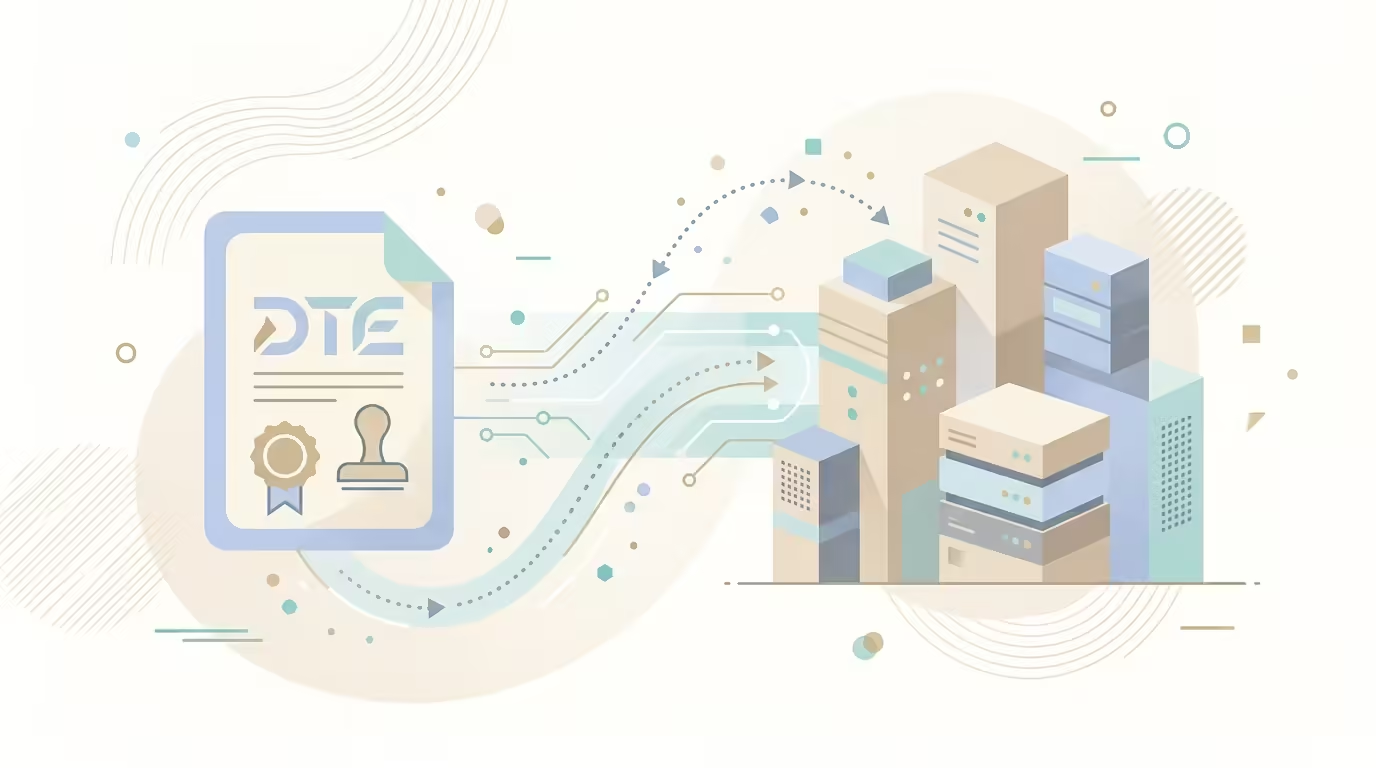

The DTE model of the Chilean SII
Chile operates under a model of Electronic Tax Documents (DTE). This means that every invoice, dispatch guide, credit note, or receipt must be generated in XML format, digitally signed, and sent to the SII for real-time validation.
The Business Central Chile localization covers that complete flow: DTE issuance, digital signature, submission to the SII, and management of acknowledgment receipts. Integration with the SII is not optional; it is the starting requirement for any commercial operation in the country.
Recent regulatory changes affecting your configuration
Chile has tightened its obligations in 2025. Since May 1, 2025, Exempt Resolution No. 53 of the SII has been in effect, introducing key changes in the way businesses must deliver receipts to end consumers in in-person sales. This regulation aims to strengthen VAT control, improve transaction traceability, and reinforce tax oversight.
Every business that makes in-person sales to end consumers and issues electronic receipts or payment vouchers must deliver a printed or virtual representation of the document to the customer according to the type of payment received. For cash or bank transfer payments, the electronic receipt must be delivered in printed or digital format. For card payments, the electronic receipt and/or electronic voucher must be delivered.
The Chile localization for Business Central allows the issuance model to be adapted directly from the ERP and to comply with the SII’s technical requirements without the need for additional development. If your company has retail or point-of-sale operations in Chile, this update requires a review of your current configuration before March 1, 2026.
Business Central Peru Localization: SUNAT, IGV, Detractions, and Electronic Books
The electronic receipts you must manage
The ecosystem of electronic receipts in Peru is broader than it first appears. SUNAT (Superintendencia Nacional de Aduanas y de Administración Tributaria) defines a complete catalog of Electronic Payment Receipts (CPE) that Business Central must be able to generate in UBL 2.1 format (XML) with a digital signature. The main ones are:
- Electronic invoice: for B2B transactions with companies that have an active RUC.
- Electronic sales receipt: for sales to end consumers (individuals without a RUC or with a DNI).
- Credit note and debit note: to cancel, correct, or adjust previously issued receipts.
- Electronic Remittance Guide (GRE): mandatory for the transfer of goods; from July 1, 2026, it is enforceable without exceptions for all taxpayers.
Issuing the wrong type of receipt not only generates a technical rejection: it can invalidate the buyer’s IGV tax credit, which makes this a real commercial relationship risk.
OSE vs. direct SUNAT: which applies to your company
In Peru there are two main routes for validating electronic receipts, and the choice is not free for all taxpayers. The first is direct issuance through SUNAT’s SEE-SOL, which is free but limited in volume and functionality. The second is through an Electronic Services Operator (OSE), a private intermediary authorized by SUNAT that validates receipts before forwarding them to the authority.
Since July 1, 2025, taxpayers with PRICO (Major Taxpayer) status whose 2023 income was equal to or greater than 300 UIT are required to issue through an OSE. The operational difference is critical: if a receipt is not sent to the OSE or to SUNAT within three calendar days of issuance, that document loses its status as an electronic invoice, even if it was delivered to the client.
The Business Central Peru localization manages this bifurcation through its integration with Gosocket as an OSE platform, centralizing the validation, signing, and traceability of receipts under a single integration point with the ERP.
Detractions in Business Central: the friction point most underestimated
Detractions are one of Peru’s most specific tax mechanisms and one of the most problematic in ERP implementations. According to SUNAT regulations, the detraction requires the buyer to deposit a percentage of the transaction amount into a Banco de la Nación account in the name of the supplier, before the supplier can access the full payment. It applies to specific goods and services such as freight transport, construction, and the sale of certain goods subject to IGV.
Since April 10, 2023, detraction information must be included directly in the electronic invoice issued, with the corresponding code and percentage, whenever the total transaction amount exceeds S/ 700. Business Central must be configured to calculate, record, and declare this field automatically; if it does not, the receipt may be flagged by SUNAT and the supplier loses access to the detractions fund to pay their tax obligations.
SIRE and electronic books in Business Central
The Peru localization for Business Central is designed to ensure correct tax management and automate key processes through its integration with Gosocket. Regarding the Integrated Electronic Records System (SIRE), since January 2025 taxpayers required to keep the Sales and Income Records and the Purchases Records must use SIRE. Business Central must generate those files in the exact format that SUNAT requires, including the Electronic Sales and Income Record (RVIE) and the Electronic Purchases Record (RCE).
Comparison table: localization requirements by country
| Country / Authority | Electronic invoice | Key taxes | Mandatory reports |
|---|---|---|---|
| Colombia / DIAN | Prior DIAN validation via authorized technology provider; mandatory CUFE/CUDE | VAT (multiple rates), source withholding, ICA, stamps | Exogenous reports (1001–1012), withholding books, third-party balances |
| Mexico / SAT | CFDI 4.0 with PAC stamping; Carta Porte 3.1 for transport | VAT (multiple rates), ISR, IEPS, local withholdings | DIOT, SAT electronic accounting, VAT declaration |
| Chile / SII | DTE (digitally signed XML); mandatory electronic receipt in B2C | VAT 19%, additional tax on beverages/tobacco | Electronic purchase/sales books, DTE dispatch guides |
| Peru / SUNAT | CPE (invoice, receipt, CN/DN, GRE) via mandatory OSE for PRICOS; Gosocket integration | IGV 18%, perceptions, withholdings, detractions (SPOT) | SIRE (RVIE + RCE), PLE, PCGE chart of accounts |
How to choose your localization extension in AppSource
Microsoft does not cover the requirements of DIAN, SAT, SII, or SUNAT on its own. Business Central localization for LATAM is implemented through extensions from certified partners available on Microsoft AppSource. Not all of them are equivalent. These are the four criteria you should evaluate before choosing:
- Certification by tax authority. The extension must have passed the official test sets of each authority (DIAN enablement, SII certification, SAT/PAC approval, SUNAT/OSE authorization). An extension without current certification cannot transmit legally valid documents, even if it generates them correctly.
- History of regulatory updates. Evaluate how frequently the ISV AppSource LATAM publishes updates in response to regulatory changes. A provider that took months to adapt its extension to CFDI 4.0 or SII Resolution No. 53 is a risk signal for your future operations.
- Multi-country support in a single extension vs. separate extensions. Some solutions cover all four countries from a single certified tax connector; others require independent extensions per market. The first option simplifies maintenance and reduces the risk of incompatibilities between Business Central versions, but you must verify that the per-country coverage is equally thorough.
- Included maintenance model. Localization is not a one-time project. Ask explicitly whether regulatory updates are included in the subscription or billed separately. A partner who does not update their localization leaves you exposed to penalties without you noticing until the audit arrives.
Common mistakes in Business Central LATAM localization projects


The failure patterns we see in real projects repeat themselves. Knowing them in advance significantly reduces risk.
- Activating the localization without configuring the technology provider. In Colombia, Mexico, and Peru, electronic invoicing requires a certified intermediary. Without that integration, Business Central generates the XML but cannot transmit it to the authority.
- Ignoring regulatory updates mid-project. Tax regulations in LATAM are constantly updated. Choose a localization with continuous updates included in the subscription.
- Mapping taxes generically. Each country has tax groups with different logic. An incorrect mapping generates silent errors that only appear in the monthly declaration.
- Underestimating withholding management in Colombia. The automation of withholding certificates and the handling of self-withholders are processes that require specific configuration; they are not covered by the global Business Central standard.
- Not certifying the system with the SII in Chile. If you are changing invoicing software or just starting out, you must go through a test set process with the SII to demonstrate that you can issue valid documents.
- Omitting the detraction field in Peruvian invoices. Since April 2023, transactions subject to detraction with an amount exceeding S/ 700 must include the code and percentage in the XML. If Business Central is not configured for this, the receipt may be flagged by SUNAT and the supplier loses access to the detractions fund to pay their tax obligations.
How to structure the localization project if you operate in multiple countries
Operating in Colombia, Mexico, Chile, and Peru from a single Business Central instance is possible. The key lies in the architecture of BC legal entities and in the choice of localization partner. A well-configured Business Central multicompany setup allows each market to be managed with its own tax logic without duplicating infrastructure.
A well-implemented localization includes adaptation to local regulations (taxes, perceptions, withholdings, electronic invoicing), regulatory reports and specific formats, and continuous updates in response to regulatory changes. That is not provided by the Microsoft standard; it is provided by the partner who implements and maintains the localization.
For multinational projects, the roadmap that works in production follows this order:
- Define the legal entity architecture by country before any tax configuration. One entity per country is the standard model; exceptions require prior analysis.
- Activate the general LATAM features and the country-specific ones in the correct order. In Peru, for example, the country/region of the legal entity’s registered address must be set to Peru and both the country-specific LATAM feature and the general LATAM feature must be activated.
- Integrate the electronic invoicing technology provider per country. In some markets, a single multi-country certified tax connector (such as Gosocket) simplifies operations: it works as a single integration point for the ERP while centralizing validation, signing, and traceability processes across different jurisdictions.
- Configure taxes, posting groups, and regulatory catalogs with the local tax team in each country. This step cannot be delegated solely to the technical team.
- Run certification tests with each tax authority before go-live.
At KCP Dynamics we carry out this process with specialized teams per market. Based on projects executed in 2023–2024, a localization project for a single country with a standard business model can be operational in between 6 and 12 weeks. Multinational projects covering all four countries simultaneously require phased planning: there is no single template that works for Colombia, Mexico, Chile, and Peru at the same time.
What to expect from post-implementation support
Business Central localization is not a one-time project. In practice, that means you need a partner who keeps the localization active: new versions of CFDI in Mexico, SII resolutions in Chile, UVT changes in Colombia, SIRE updates in Peru. A partner who does not update their localization leaves you exposed to penalties without you noticing until the audit arrives.
The support that really matters includes: early alerts on regulatory changes, updates to the AppSource extension without interrupting operations, and functional guidance to reconfigure taxes when the law changes. At KCP Dynamics, that is the model we work with for our clients in LATAM.
Frequently asked questions
Does Business Central include LATAM localization natively?
Business Central includes base functionality for some countries, but full tax localization (certified electronic invoicing, specific regulatory reports, integration with tax authorities) requires extensions from certified partners available on Microsoft AppSource. Microsoft does not cover the requirements of DIAN, SAT, SII, or SUNAT on its own.
Can I use a single Business Central instance for Colombia, Mexico, Chile, and Peru?
Yes, it is possible through a multi-company architecture with separate legal entities per country. Each legal entity has its own tax configuration, its own tax groups, and its own electronic invoicing connector. Centralized management is a real advantage for multinational groups, as long as the localization is correctly configured per country.
How long does it take to implement Business Central localization in a LATAM country?
It depends on the complexity of the business and the number of legal entities. A localization project for a single country, with a standard business model, can be operational in between 6 and 12 weeks. Multinational projects covering multiple countries simultaneously require phased planning and specialized teams per market.
What happens if tax regulations change after implementation?
Certified localizations are updated periodically to reflect changes in legislation. Your implementation partner is responsible for keeping those updates active in your environment. If your partner does not offer continuous localization maintenance, you are assuming a real regulatory risk that can lead to penalties or document rejections.