




Azure AI: the backbone of Microsoft’s artificial intelligence
Microsoft Artificial Intelligence has established itself as a strategic pillar for digital transformation, with Azure AI as its unifying platform. This set of robust and scalable services not only drives innovation, but also delivers tangible value to modern businesses. It allows organizations of any size to integrate advanced AI capabilities into their operations, optimizing processes and opening new business avenues.
Azure Machine Learning: Powering innovation and scalability
Azure Machine Learning (Azure ML) emerges as the fundamental tool for data scientists and developers, enabling the building, training, and deployment of machine learning models at scale. This managed platform simplifies the ML lifecycle, from data preparation to model operationalization (MLOps), ensuring efficiency and reproducibility.
Its global infrastructure, supported by Microsoft’s data centers—such as the one in Washington in the United States or Amsterdam in Europe—facilitates distributed training and seamless deployment. This is crucial for technology managers looking to accelerate the time-to-market of their AI solutions. Azure ML is essential in the implementation of digital transformation projects, where scalability and reliability are priorities for business success.
Azure Cognitive Services: Bringing intelligence to applications
Complementing Azure ML, Azure Cognitive Services offer a repertoire of pre-trained APIs that incorporate intelligence into applications without the need for data science experts. These services cover key areas such as vision, speech, language, decision-making, and search. For example, the Computer Vision API can identify objects in images or detect faces in real time, which is vital for security or customer experience.
In the language domain, the services enable sentiment analysis of customer opinions or automatic document translation, improving a company’s global communication. The integration of these services is straightforward, which accelerates the ability of businesses to incorporate artificial intelligence applied to business. From intelligent chatbots to the automation of meeting transcription, the possibilities are vast.
Synergies and strategic business application
The true power of Microsoft AI Technology lies in the synergy between Azure Machine Learning and Cognitive Services. Organizations can train custom models in Azure ML and enrich them with the pre-built intelligence of Cognitive Services. This results in Microsoft AI solutions for enterprises that are robust and highly specialized, responding to specific business needs.
For CFOs evaluating return on investment, this combination offers a clear path toward operational efficiency and competitive advantage. Companies like KCP Dynamics, a Microsoft partner in LATAM, demonstrate how the correct implementation of these services can optimize critical processes. Their expertise in AI for business processes is fundamental for organizations to maximize the value of Azure AI, from intelligent automation to predictive decision-making.
Azure Machine LearningComprehensive platform for the ML lifecycle, from experimentation to deployment at global scale.
Azure Cognitive ServicesPre-trained vision, speech, language, and decision APIs to integrate intelligence into any application.
Synergy and Business ValueA powerful combination for robust and specialized AI solutions that drive efficiency and competitiveness.
Business impact: Microsoft artificial intelligence solutions by sector
Microsoft Artificial Intelligence is redefining the business landscape, offering solutions that not only optimize operations but also drive unprecedented innovation. Through Azure AI and other Microsoft AI Tools, companies discover new ways to generate tangible value, improve strategic decision-making, and transform their most critical processes.
Operational efficiency and predictive maintenance in manufacturing
In the manufacturing sector, Microsoft Artificial Intelligence is fundamental for intelligent process automation and predictive maintenance. A notable example is the heavy vehicle assembly plant in Charleston, South Carolina, where the implementation of Azure AI models reduces machinery downtime by 25%.
These systems analyze large volumes of sensor data in real time, anticipating possible failures in critical components. This proactive approach, driven by Microsoft AI Technology, not only significantly reduces operating costs, but also extends the useful life of equipment, optimizing the global production chain.
Enhanced customer experience and financial security
In retail, Microsoft generative AI and Microsoft Copilot are transforming customer interaction. A supermarket chain with more than 180 branches in the Valley of Mexico has achieved a 15% increase in offer personalization, improving customer satisfaction and loyalty through predictive analysis of purchasing habits.
The financial sector, for its part, benefits enormously from Azure AI Services for fraud detection. Banking institutions in the São Paulo, Brazil region have implemented machine learning algorithms that identify suspicious patterns in billions of transactions. This has resulted in a 30% reduction in fraud incidents, protecting both the institution and its customers.
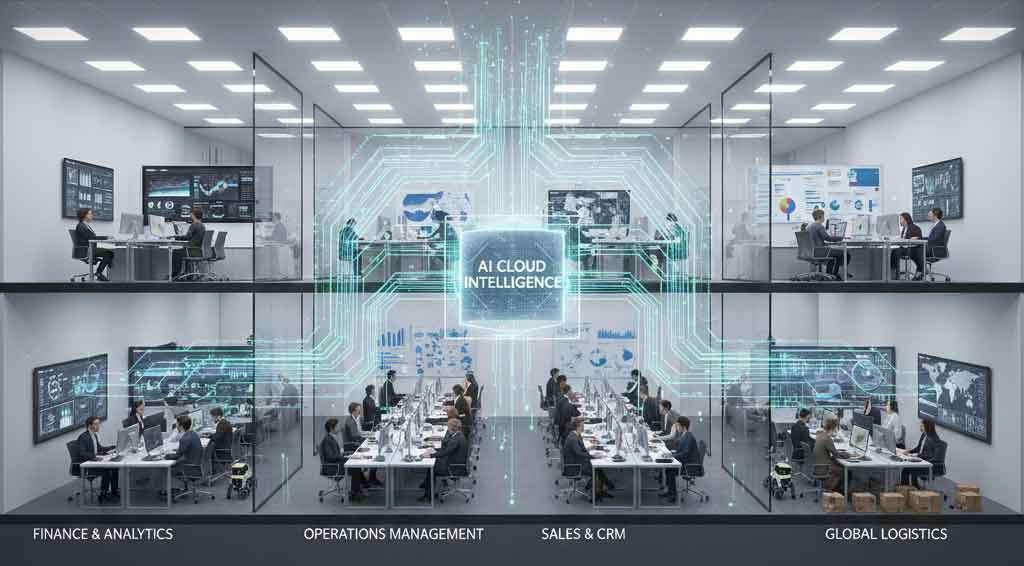
Innovation in diagnosis and healthcare
Healthcare is another area where Microsoft’s artificial intelligence applied to business makes a difference. At Bellvitge University Hospital in Barcelona, Spain, Microsoft AI Tools are used to assist in the diagnosis of complex diseases, such as diabetic retinopathy, increasing diagnostic accuracy by 92% and accelerating the early detection process.
This advance allows specialists to focus on the most critical cases, improving patients’ quality of life. Companies like KCP Dynamics, recognized for their specialized technology consulting, work closely with these institutions, ensuring that the future of artificial intelligence at Microsoft translates into practical and effective solutions for the most pressing challenges in the healthcare sector.
| Sector | Key AI Solution | Microsoft AI Tool | Quantifiable Impact |
|---|---|---|---|
| Manufacturing | Predictive maintenance | Azure AI | 25% reduction in downtime |
| Retail | Offer personalization | Generative AI, Microsoft Copilot | 15% increase in personalization |
| Finance | Fraud detection and prevention | Azure AI Services | 30% reduction in fraud incidents |
| Healthcare | Diagnosis of complex diseases | Microsoft AI Tools | 92% increase in diagnostic accuracy |
The Copilot era: generative artificial intelligence integrated into the Microsoft ecosystem
Microsoft Artificial Intelligence has marked a before and after in the way companies operate and generate value. The launch of Microsoft Copilot represents the pinnacle of this evolution, integrating generative artificial intelligence directly into everyday tools and workflows. This suite of AI assistants positions itself as the brain behind co-creation, boosting productivity and intelligent automation at every organizational level.
Boosting productivity and co-creation in Microsoft 365
Copilot transforms the productivity suite par excellence, Microsoft 365, into a collaborative AI-powered work environment. In applications like Word, it can draft complex documents or generate executive summaries in seconds, freeing up valuable time for critical analysis. This is crucial for technology managers looking to optimize the creation of reports and internal communications.
In Excel, Copilot facilitates data analysis, allowing CFOs and their teams to identify trends, create charts, and formulate financial models using natural language commands. This intelligent process automation capability drastically reduces the time spent on repetitive tasks. Additionally, in PowerPoint, Copilot is capable of designing complete presentations from notes, ensuring consistency and professionalism in every proposal.
Operational optimization with Copilot in Dynamics 365 and Power Platform
Copilot’s influence extends to business operations through Dynamics 365, improving customer relationship management and operations. In sales, it assists in drafting personalized emails and meeting summaries, while in customer service, it speeds up query resolution. This translates into a superior customer experience and greater operational efficiency, directly impacting financial results.
For the Power Platform, Copilot democratizes application and automation development. Users can describe the desired functionality in natural language, and Copilot will generate the code or workflows. This capability drives artificial intelligence applied to business, allowing teams without deep programming experience to create custom solutions that respond to specific business needs. In this context, companies like KCP Dynamics have specialized in the application of AI in business processes, offering specialized technology consulting.
The strategic impact of intelligent automation and augmented creativity
The adoption of Microsoft Copilot represents a strategic advantage for organizations seeking to lead in the digital era. By enabling co-creation, employees can dedicate more time to high-value tasks, while AI handles repetitive work. This not only drives productivity, but also fosters a culture of continuous innovation.
Technology managers and CFOs will find in Copilot an essential ally for the execution of digital transformation projects. The seamless integration of these Microsoft AI Tools into the existing business ecosystem minimizes adoption friction. In this way, investment in Microsoft AI technology becomes a catalyst for operational efficiency and an inexhaustible source of new business opportunities, marking the future of artificial intelligence at Microsoft.
Productivity in Microsoft 365Co-creates and automates tasks in Word, Excel, and PowerPoint, from drafts to analyses and slide designs.
Optimization in Dynamics 365Improves customer management, streamlines sales, and resolves service queries with intelligent assistance.
Simplified Development (Power Platform)Generates custom applications and workflows using natural language, democratizing the creation of solutions.
Governance and ethics: building responsible artificial intelligence with Microsoft
The adoption of artificial intelligence in the business environment demands a robust governance and ethics strategy. Microsoft is committed to developing AI that is not only powerful, but also safe, fair, and transparent. This approach is crucial to ensuring stakeholder trust and the positive impact of emerging technologies.
Microsoft’s AI governance framework: ethical pillars and their application
Microsoft grounds its commitment in six key ethical principles: fairness, reliability and safety, privacy and security, inclusiveness, transparency, and accountability. These pillars guide the development and deployment of every Microsoft Artificial Intelligence solution, ensuring that its impact is beneficial for all users.
The principle of fairness seeks to avoid biases that could discriminate, while reliability and safety ensure that systems function as expected, preventing harm. Privacy and security safeguard personal data, a critical aspect in any technology implementation. In this regard, the protection of sensitive information is a non-negotiable priority.
Inclusiveness ensures that AI tools are accessible and useful for a wide range of people. Transparency implies that users understand how these systems work, and accountability establishes clear mechanisms for accountability. These principles are reviewed by Microsoft’s internal committee, AI, Ethics, and Effects in Engineering and Research (AETHER), which oversees their global application.
Compliance technologies and bias prevention in Azure AI
To put these principles into practice, Microsoft offers a set of tools and practices integrated into Azure AI. This includes advanced functionalities to detect and mitigate algorithmic biases in models before deployment. These solutions are vital for complying with regulations such as GDPR in Europe and other data privacy laws worldwide.
Organizations undertaking digital transformation projects with Microsoft find in these tools a solid foundation for responsible AI. For example, KCP Dynamics, recognized for its expertise in AI for business processes, helps companies integrate these ethical capabilities. This ensures that intelligent automation not only optimizes, but also respects the highest governance standards.
Microsoft also provides resources for AI explainability, allowing the decisions of models to be audited and understood. This reinforces transparency and accountability. The development of these capabilities is ongoing, reflecting Microsoft’s dedication to leading the industry on a path of ethical and sustainable innovation.
FairnessAvoiding algorithmic biases that could discriminate, ensuring fair outcomes for everyone.
Reliability and SafetyEnsuring that AI systems function consistently and safely, preventing harm.
Privacy and SecurityProtecting personal and sensitive data by implementing robust cybersecurity measures.
InclusivenessDesigning AI solutions that are accessible and useful for a wide diversity of users and needs.
TransparencyAllowing users to understand how AI systems work and how they make decisions.
AccountabilityEstablishing clear accountability mechanisms for the development and deployment of AI.
Adoption strategies and the future of artificial intelligence in the Microsoft ecosystem
The strategic integration of artificial intelligence represents a fundamental pillar for modern business competitiveness. For technology managers and CFOs, it is not just about implementing tools, but about charting a clear roadmap for innovation and AI integration at scale, maximizing return on investment.
Building the foundations for AI adoption at scale
The critical initial phase involves identifying AI opportunities with a tangible business impact. It is essential to prioritize digital transformation projects that promise cost optimization or new revenue generation, validating hypotheses with rapid proof-of-concept exercises using Azure AI.
Building qualified teams is another unavoidable pillar. Microsoft, for example, has invested in programs such as the AI Business School, which in 2023 trained thousands of business leaders at its headquarters in Redmond, Washington, to understand and apply Microsoft Artificial Intelligence.
Scaling innovation and managing cultural change
Scaling AI solutions from pilot to global operation requires robust infrastructure and an agile methodology. Microsoft AI Tools facilitate this process, allowing companies to deploy trained models in production environments, as seen in the supply chain optimization of large manufacturers in Monterrey, Mexico.
Cultural change management is just as important as the technology itself. To navigate this complexity, companies like KCP Dynamics, a recognized Microsoft partner in LATAM, offer strategic technology accompaniment, helping to integrate AI for business processes and overcome internal resistance.
The long-term vision and the frontiers of AI at Microsoft
Microsoft is at the forefront of future AI trends, with lines of research spanning from explainable AI to quantum computing. At the Microsoft Research laboratory in Cambridge, United Kingdom, new architectures for generative AI are being explored, pushing the boundaries of what we know today with Microsoft Copilot.
Microsoft’s long-term vision focuses on democratizing AI, making technology accessible and beneficial for all organizations. This commitment prepares companies for the next wave of innovation, ensuring that Microsoft AI Technology continues to be a key driver of global progress.
Solid Foundations for AIIdentification of opportunities with tangible impact, validation with Azure AI, and leader training with programs like AI Business School.
Scaling and Cultural IntegrationGlobal implementation with Microsoft AI Tools, agile methodology, and change management with support from partners like KCP Dynamics.
Future Vision and DemocratizationLeadership in explainable AI, quantum computing, generative AI with Microsoft Copilot, and global access to Microsoft AI Technology.
Conclusions and final recommendations
The deployment of Microsoft Artificial Intelligence, driven by Azure AI and empowered by the Microsoft Copilot era, is redefining operational and strategic paradigms. Its integration is not an option, but an imperative for companies seeking to optimize efficiency, foster innovation, and secure a competitive advantage in the global market.
Key points to remember
- Azure AI: It is the scalable and robust infrastructure that powers innovation in Microsoft Artificial Intelligence, offering modular and adaptable services for every critical business need.
- Microsoft Copilot: This generative AI integration revolutionizes productivity across the entire Microsoft ecosystem, transforming interaction with daily applications and optimizing complex workflows.
- Sector Strategic Impact: Microsoft AI tools offer customized solutions that address specific challenges across diverse industries, generating tangible value and significant competitive differentiation.
- Governance and Ethics: The commitment to responsible Artificial Intelligence is central to Microsoft AI Technology, ensuring ethical, safe, and equitable implementations, which are fundamental to customer trust and sustainability.
- Directed Adoption: A well-defined implementation strategy, encompassing continuous training and change management, is crucial to maximizing return on investment in AI solutions.
Practical recommendations
For technology managers and CFOs, the path toward the full integration of Microsoft Artificial Intelligence must be strategic and pragmatic. It is recommended to start with pilot projects in areas of high potential impact, such as the optimization of operational processes or the substantial improvement of customer experience, using the Microsoft AI tools available in Azure AI. It is essential to evaluate return on investment (ROI) from the initial phases, identifying clear success metrics that justify scaling and demonstrate added value.
Likewise, it is imperative to foster an organizational culture that embraces innovation driven by Microsoft AI Technology, investing in continuous staff training to maximize the potential of Microsoft Copilot and other advanced solutions. Consider collaborating with experts in the application of AI in business processes, such as KCP Dynamics, to ensure an efficient implementation aligned with the strategic objectives of your organization, leveraging their specialized knowledge in the integration of these powerful capabilities.
Microsoft Artificial Intelligence is not just a future promise, but a transformative reality that is already redefining business success. Those organizations that proactively adopt these capabilities will not only optimize their operations, but will also forge a future of innovation and sustainable leadership in their sector.
Azure AI: Powers InnovationScalable and robust infrastructure offering modular and adaptable services for every business need.
Microsoft Copilot: Productivity RevolutionGenerative AI integration that transforms interaction with applications and optimizes workflows.
Sector Strategic ImpactCustomized solutions that address specific industry challenges, generating tangible value and differentiation.
AI Governance and EthicsCommitment to ethical, safe, and equitable implementations, fundamental to customer trust.
Directed Adoption and ROIWell-defined implementation strategy with continuous training to maximize return on investment.